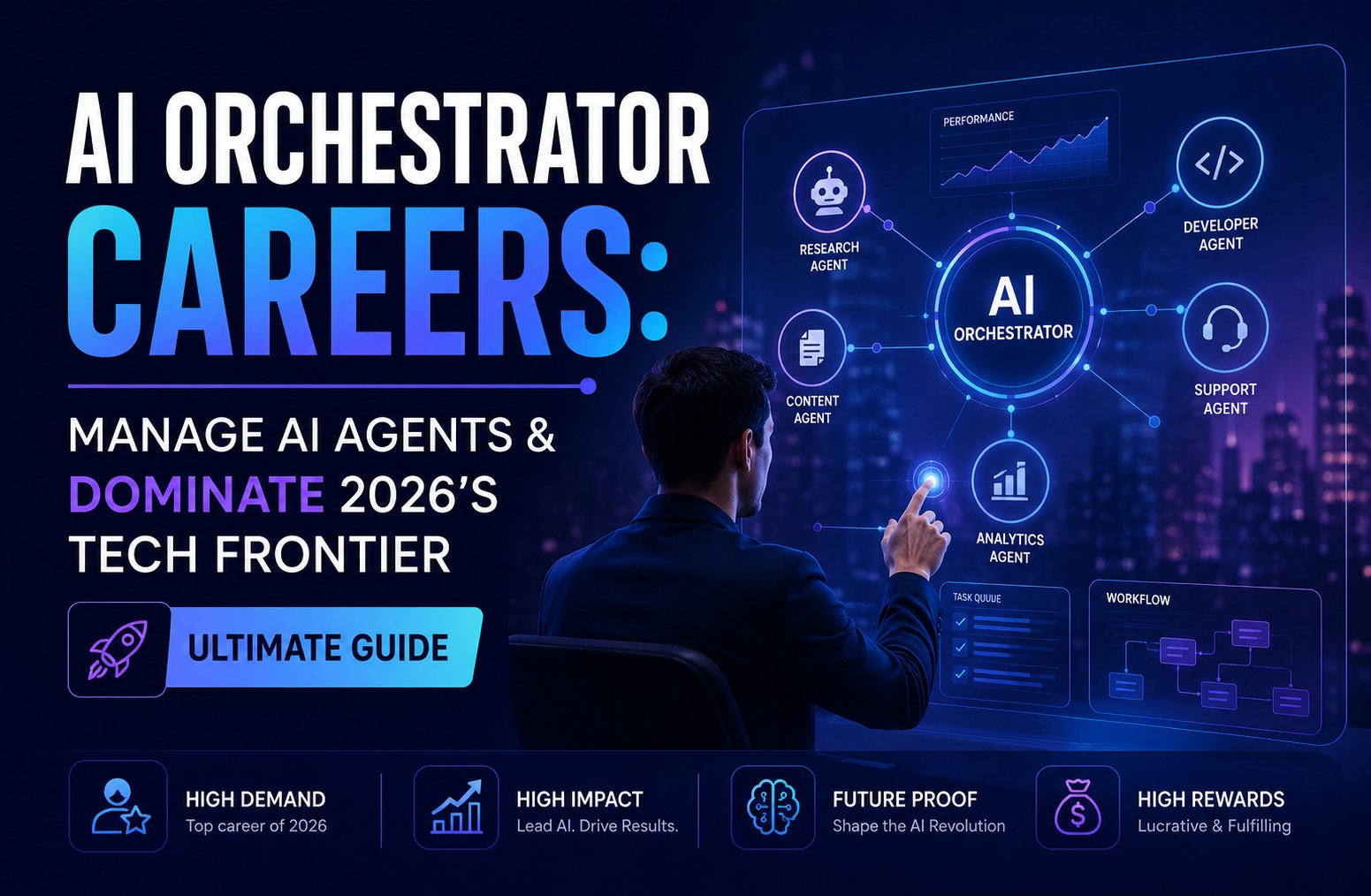
AI Orchestrator The Future Career Managing Multiple AI Systems (2026 Guide)
Artificial Intelligence is evolving rapidly. Companies are no longer using just one AI tool they now use multiple AI systems together for automation, analytics, customer support, coding, content generation, and operations.
This has created a powerful new role:
👉 AI Orchestrator
An AI Orchestrator manages, coordinates, and optimizes multiple AI tools, workflows, and agents to ensure they work together efficiently.
In simple words:
An AI Orchestrator acts like a “conductor” of AI systems.
As businesses adopt AI at scale, AI orchestration is becoming one of the most valuable and future-proof careers of 2026.
What Is an AI Orchestrator?
An AI Orchestrator is responsible for:
- Connecting multiple AI tools
- Designing AI workflows
- Automating business processes
- Managing AI agents
- Optimizing AI performance
- Ensuring smooth communication between systems
Instead of using AI manually, companies now automate complete workflows using orchestration.
Example:
- AI chatbot collects customer query
- Another AI analyzes intent
- CRM system updates automatically
- AI generates response
- Dashboard tracks insights
The orchestrator ensures everything works together.
Why AI Orchestration Is Exploding in 2026
1. Companies Use Multiple AI Tools
Businesses now use:
- AI chatbots
- AI analytics
- AI automation tools
- AI coding assistants
- AI design systems
Someone must connect them efficiently.
2. AI Automation Is Becoming Enterprise-Scale
Companies want complete automation not isolated AI tools.
3. Rise of AI Agents
Autonomous AI agents now perform:
- Research
- Reporting
- Customer support
- Workflow management
These agents require orchestration.
4. Productivity Pressure
Organizations want:
- Faster operations
- Lower costs
- Higher efficiency
AI orchestration delivers this.
5. AI Governance & Security
Companies need professionals who manage:
- AI permissions
- Workflow control
- Compliance
- Data flow
What Does an AI Orchestrator Actually Do?
1. Connect AI Systems
Integrates:
- Chatbots
- Databases
- APIs
- Automation tools
2. Build AI Workflows
Designs automated pipelines for tasks.
3. Manage AI Agents
Coordinates multiple AI agents working together.
4. Optimize Prompts & Outputs
Improves AI accuracy and efficiency.
5. Monitor Performance
Tracks:
- Speed
- Errors
- AI quality
- Productivity gains
6. Automate Business Processes
Examples:
- Customer support automation
- AI reporting systems
- Content pipelines
- HR automation
Skills Required to Become an AI Orchestrator
Technical Skills
1. Understanding AI Tools
Knowledge of:
- ChatGPT
- Claude
- Gemini
2. Workflow Automation
Tools like:
- Zapier
- Make
- n8n
3. API Integration
Connecting systems programmatically.
4. Prompt Engineering
Creating optimized AI instructions.
5. Data Handling
Managing structured workflows and analytics.
6. Basic Coding
Helpful languages:
- Python
- JavaScript
Soft Skills
- Systems thinking
- Problem solving
- Process optimization
- Communication
- Strategic thinking
Tools Used by AI Orchestrators
AI Platforms
- ChatGPT
- Claude
- Gemini
Automation Platforms
- Zapier
- Make
- n8n
AI Development Tools
- LangChain
- Flowise
- AutoGen
- CrewAI
Project Management
- Notion
- Jira
- Slack
Career Roles Related to AI Orchestration
1. AI Workflow Architect
Designs enterprise AI systems.
2. AI Automation Specialist
Automates operational processes.
3. Prompt Engineer
Optimizes AI instructions.
4. AI Product Manager
Manages AI-powered products.
5. AI Operations Manager
Handles AI system deployment and scaling.
6. AI Integration Consultant
Helps companies adopt AI workflows.
Industries Hiring AI Orchestrators
- SaaS companies
- Marketing agencies
- Fintech startups
- Healthcare tech companies
- E-commerce platforms
- Consulting firms
- Enterprise automation companies
AI orchestration demand is rising across all industries.
Salary of AI Orchestrators (2026)
India
| Role | Salary Range |
|---|---|
| AI Automation Specialist | ₹8 – ₹18 LPA |
| Prompt Engineer | ₹10 – ₹25 LPA |
| AI Workflow Architect | ₹15 – ₹40 LPA |
| AI Product Consultant | ₹20 – ₹50 LPA |
Global
- USA: $100,000 to $250,000+
- UK: £70,000 to £150,000
- Canada: $90,000 to $180,000
AI orchestration is becoming a premium skillset.
How to Become an AI Orchestrator (Step by Step Roadmap)
Step 1: Learn AI Basics
Understand:
- LLMs
- AI workflows
- Prompt engineering
Step 2: Learn Automation Tools
Start with:
- Zapier
- Make
Step 3: Learn Prompt Engineering
Practice optimizing prompts for different tasks.
Step 4: Learn API Integration
Understand how AI tools communicate.
Step 5: Build AI Workflows
Examples:
- AI customer support system
- Automated reporting system
- AI content generation pipeline
Step 6: Learn Multi Agent Systems
Explore:
- CrewAI
- LangChain
- AutoGen
Step 7: Build Portfolio Projects
Show:
- Workflow diagrams
- AI automation demos
- Productivity systems
Future Scope of AI Orchestration (2026 to 2035)
1. Multi Agent AI Systems
AI agents collaborating autonomously.
2. AI-First Businesses
Entire operations managed by AI workflows.
3. Autonomous Enterprises
Self-operating digital systems.
4. AI Governance Roles
Managing ethical and secure AI operations.
5. Human + AI Collaboration
AI orchestrators becoming strategic business roles.
This field is still early → massive future potential.
Benefits of Becoming an AI Orchestrator
✔ Extremely future proof
✔ High salary potential
✔ Works across industries
✔ Combines creativity + technology
✔ Remote opportunities
✔ No traditional degree always required
Challenges
❌ AI tools evolve rapidly
❌ Requires constant learning
❌ Complex workflow debugging
❌ Integration challenges
Conclusion
AI Orchestration is emerging as one of the most important careers of the AI era. As businesses move from isolated AI tools to fully automated AI ecosystems, professionals who can coordinate, optimize, and manage AI workflows will become indispensable.
If you want a career at the center of:
- AI
- Automation
- Business systems
- Future technology
Then becoming an AI Orchestrator could be one of the smartest career moves of 2026.