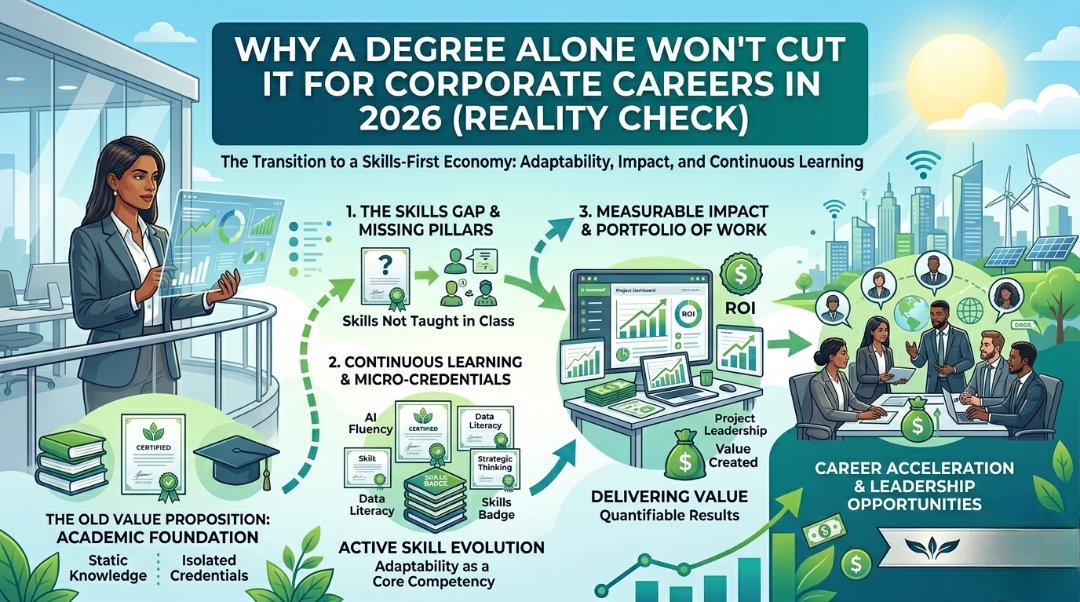
Why a Degree Is No Longer Enough for a Corporate Career (2026 Reality Check)
A college degree was once considered the golden ticket to a stable corporate job. Graduate, get hired, build a career that used to be the formula.
Not anymore.
In 2026, companies are hiring not just for degrees, but for skills, adaptability, digital literacy, and problem solving ability.
Today, a degree may help open the door but skills decide whether you grow inside the room.
The Corporate World Has Changed
The job market has evolved faster than traditional education.
Companies now operate in a world driven by:
- Automation
- Artificial Intelligence
- Data
- Digital transformation
- Remote collaboration
- Rapid innovation
Many university curriculums struggle to keep up.
That’s why employers increasingly value practical skills over paper qualifications.
Why a Degree Alone Is No Longer Enough
1. Degrees Often Teach Theory, Companies Need Application
A degree may teach concepts.
Employers want people who can:
- Solve real business problems
- Use modern tools
- Execute tasks immediately
- Companies hire for results.
2. Skills Are Becoming More Valuable Than Titles
Many employers now prioritize:
- What you can do
- What tools you know
- What problems you can solve
Instead of just:
- Which degree you have
- Which college you attended
Skill first hiring is growing rapidly.
3. Technology Changes Too Fast
By the time some academic programs update their syllabus
Industries have already moved ahead.
Examples:
- AI tools
- Cloud platforms
- Data analytics
- Automation software
- Continuous upskilling matters.
4. Companies Want Job Ready Talent
Employers prefer candidates who can contribute from day one.
That means:
- Hands on knowledge
- Industry certifications
- Project experience
- Portfolio work
- Not just academic marks.
5. Competition Is Global
- You no longer compete only with people in your city.
- Remote work means you compete globally.
- To stand out, you need more than a degree.
What Companies Are Hiring For Now
1. Skills
Examples:
- Data analysis
- Digital marketing
- Cloud computing
- Cybersecurity
- Product management
- Prompt engineering
Specialized skills increase employability.
2. Certifications
Recognized certifications often carry major value.
Examples:
- Amazon Web Services certifications
- CompTIA certifications
- Google Career Certificates
- Corporate Finance Institute programs
These prove practical capability.
3. Problem Solving Ability
Companies love people who can:
- Think critically
- Solve challenges
- Improve processes
Problem solvers get promoted.
4. Communication Skills
Corporate growth often depends on:
- Presentations
- Team collaboration
- Negotiation
- Leadership communication
Soft skills matter hugely.
5. Adaptability
The most valuable professionals can learn fast.
The future belongs to adaptable people.
Why Upskilling Has Become Mandatory
Upskilling is no longer optional.
It is survival.
Professionals now continuously learn:
- New tools
- Industry trends
- Emerging technologies
- Leadership skills
This is how careers grow.
The Rise of Skill Based Hiring
Many companies now hire based on:
- Portfolios
- Projects
- Certifications
- Skill tests
- Practical assessments
Some roles no longer require traditional degrees at all.
Especially in:
- Tech
- Design
- Digital marketing
- Startups
- AI related roles
Examples Where Skills Often Beat Degrees
Technology
A strong developer portfolio may matter more than a degree.
Digital Marketing
Results matter more than academic background.
Data Analytics
Projects + tools often outweigh generic degrees.
UI/UX Design
Portfolio often matters more than qualifications.
Prompt Engineering / AI Roles
Emerging roles often prioritize demonstrated skill.
What a Modern Corporate Career Actually Needs
Today you need a combination of:
Degree
Still useful as foundation.
Skills
Practical, current, job-ready abilities.
Certifications
Industry recognized credibility.
Projects
Proof you can apply what you know.
Experience
Internships, freelance, practical exposure.
Degree alone is no longer enough.
Combination wins.
High Value Skills Companies Want in 2026
Tech Skills
- AI & Machine Learning
- Data Analytics
- Cloud Computing
- Cybersecurity
- Full Stack Development
Business Skills
- Financial Modeling
- Product Management
- Digital Marketing
- Business Analytics
Future Skills
- Prompt Engineering
- Automation
- ESG & Sustainability
- AI tools mastery
These often boost careers faster than degrees alone.
How to Stay Relevant in Corporate
Careers
1. Keep Learning
Always update your skillset.
2. Earn Certifications
Add market-recognized credentials.
3. Build Portfolio Projects
Show what you can do.
4. Follow Industry Trends
Stay current.
5. Learn Tools Employers Use
Be practical, not just theoretical.
What Employers Really Ask Today
Increasingly they ask:
Not:
- “What degree do you have?”
But:
- “What can you build?”
- “What can you solve?”
- “What tools do you know?”
- “What results have you delivered?”
That is a major shift.
Future of Corporate Hiring (2026 to 2035)
1. Skill First Hiring Will Grow
More companies moving away from degree-only filters.
2. AI Will Change Job Roles
Workers must adapt constantly.
3. Certifications Will Gain More Value
Practical credentials rising.
4. Lifelong Learning Will Become Normal
Career growth will depend on continuous upskilling.
Benefits of Going Beyond a Degree
✔ Higher salary potential
✔ Faster promotions
✔ Better job security
✔ More career options
✔ Global opportunities
✔ Stronger personal brand
Biggest Mistake Graduates Make
Thinking:
“Now my education is complete.”
In reality
Graduation is often where real career learning begins.
Conclusion
A degree still matters but by itself, it is no longer enough for a successful corporate career.
In today’s world, companies hire and promote people who combine:
- Education
- Skills
- Certifications
- Practical experience
- Adaptability
The professionals who keep learning will outperform those who stop at a degree.
In 2026, your degree may get you shortlisted. Your skills get you hired. Your adaptability gets you promoted.