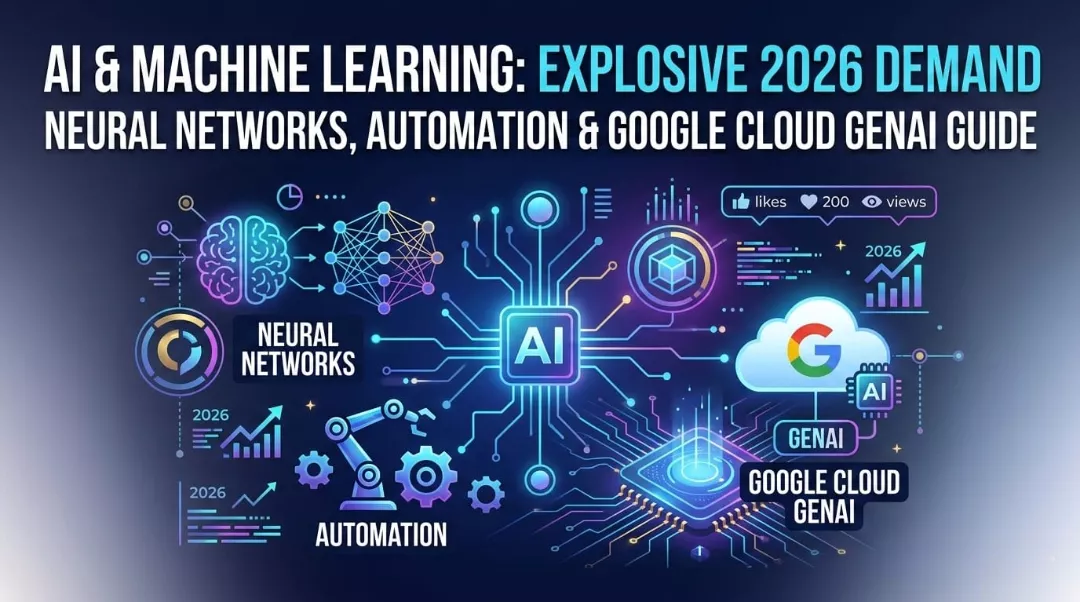
AI & Machine Learning Explosive Demand in 2026 (Neural Networks, Automation & Google Cloud GenAI Guide)
Artificial Intelligence (AI) and Machine Learning (ML) are no longer future concepts they are the foundation of modern technology. From recommendation engines and fraud detection to self-driving cars and AI copilots, ML systems now power almost every industry.
With courses like Google Cloud’s Introduction to Generative AI, professionals can now quickly enter one of the most in demand tech careers of 2026.
This guide explains:
- What AI & ML really mean
- Why demand is exploding
- What neural networks do
- Role of automation
- Skills required
- Career paths
- Salary expectations
- Roadmap to enter the field
What Is AI & Machine Learning?
Artificial Intelligence (AI)
AI refers to systems that mimic human intelligence learning, reasoning, problem-solving, and decision making.
Machine Learning (ML)
ML is a subset of AI where machines learn patterns from data instead of being explicitly programmed.
Generative AI (GenAI)
GenAI models (like large language models) generate:
- Text
- Code
- Images
- Audio
- Insights
Together, AI + ML + GenAI create intelligent systems capable of automation and innovation.
Why AI & ML Demand Is Exploding in 2026
1. AI Integration Across Industries
AI is now used in:
- Healthcare
- Finance
- Retail
- Manufacturing
- Marketing
- Agriculture
- Education
2. Automation Revolution
Companies want:
- Automated workflows
- AI chatbots
- Smart analytics
- Predictive systems
3. Rise of Neural Networks
Deep learning models outperform traditional systems in:
- Image recognition
- Speech recognition
- NLP
4. Cloud AI Growth
Platforms like Google Cloud, AWS, and Azure make AI accessible to everyone.
5. GenAI Adoption
Businesses are rapidly integrating generative AI tools into operations.
6. Shortage of Skilled AI Professionals
Demand far exceeds supply → high salary opportunities.
What You Learn in Courses Like Google Cloud Intro to GenAI
Programs such as Google Cloud’s Introduction to Generative AI typically focus on:
1. Basics of AI & ML
- Supervised learning
- Unsupervised learning
- Model evaluation
2. Neural Networks
- Artificial neurons
- Backpropagation
- Activation functions
- Deep learning basics
3. Large Language Models (LLMs)
- Transformers
- Prompt engineering
- Text generation
- Embeddings
4. AI Automation
- Workflow automation
- AI-powered chatbots
- API integration
5. Cloud Deployment
- Hosting AI models
- Using AI APIs
- Integrating AI into apps
6. Responsible AI
- Ethics
- Bias reduction
- Security
These beginner friendly courses provide a strong foundation in GenAI and ML concepts.
Understanding Neural Networks (Simplified)
Neural networks are inspired by the human brain.
They consist of:
- Input layer
- Hidden layers
- Output layer
Neural networks are used in:
- Face recognition
- Fraud detection
- Speech to text
- Autonomous vehicles
- AI chatbots
Advanced versions include:
- CNNs (for images)
- RNNs (for sequences)
- Transformers (for language models)
Neural networks are the backbone of modern AI.
How Automation Is Powered by AI
AI enables automation in:
✔ Customer Support (Chatbots)
✔ HR Resume Screening
✔ Fraud Detection
✔ Marketing Campaign Personalization
✔ Automated Reporting
✔ Inventory Forecasting
✔ Robotic Process Automation (RPA)
✔ Smart Manufacturing
Automation reduces cost and increases efficiency.
Core Skills Required for AI & ML Careers
1. Programming
- Python (must)
- SQL
2. Mathematics
- Linear algebra
- Probability
- Statistics
- Calculus basics
3. Machine Learning
- Regression
- Classification
- Clustering
4. Deep Learning
- Neural networks
- CNN
- RNN
- Transformers
5. Generative AI
- Prompt engineering
- RAG systems
- Fine tuning models
6. Cloud Platforms
- Google Cloud
- AWS
- Azure
7. Data Handling
- Pandas
- NumPy
- Data preprocessing
Career Roles in AI & Machine Learning (2026)
1. Machine Learning Engineer
Builds and deploys ML models.
2. AI Engineer
Develops AI powered systems.
3. Generative AI Developer
Builds LLM based applications.
4. Data Scientist
Applies ML to business problems.
5. NLP Engineer
Works on language models.
6. AI Automation Specialist
Implements AI workflow systems.
7. Computer Vision Engineer
Works on image recognition systems.
8. AI Product Manager
Leads AI based product development.
Salary of AI & ML Professionals (2026)
India
| Role | Salary Range |
|---|---|
| ML Engineer | ₹8 – ₹25 LPA |
| AI Engineer | ₹10 – ₹35 LPA |
| GenAI Developer | ₹12 – ₹40 LPA |
| Senior AI Scientist | ₹20 – ₹60 LPA |
USA
$100,000 to $200,000+
UK
£60,000 to £130,000
Canada
$80,000 to $150,000
AI professionals are among the highest-paid tech roles.
How to Enter AI & ML (Step by Step Roadmap)
Step 1: Learn Python
Master:
- Variables
- Functions
- Libraries
Step 2: Learn Math Foundations
Statistics and probability.
Step 3: Learn ML Basics
Start with:
- Scikit learn
- Basic models
Step 4: Learn Neural Networks
Use:
- TensorFlow
- PyTorch
Step 5: Learn Generative AI
- LLM concepts
- Prompt engineering
- API usage
Step 6: Build Projects
Examples:
- Chatbot
- Image classifier
- Sales prediction model
- AI automation tool
Step 7: Learn Cloud Deployment
Use Google Cloud or AWS.
Step 8: Build Portfolio
Upload projects to GitHub.
Step 9: Apply for AI Roles
Best Beginner Courses (2026)
✔ Google Cloud Intro to GenAI
✔ Machine Learning by Andrew Ng
✔ IBM AI Engineering
✔ DeepLearning.AI Generative AI Courses
✔ TensorFlow Developer Certification
Future Scope of AI & ML (2026 to 2035)
1. AI-First Businesses
Every company will use AI.
2. Smart Automation Systems
Fully automated business processes.
3. AI Personal Assistants
Workplace copilots for every employee.
4. AI Driven Healthcare
Personalized medicine.
5. Autonomous Systems
Self-driving vehicles & robotics.
6. AI Governance & Regulation
New career areas in AI compliance.
AI & ML will dominate technology for the next decade.
Benefits of AI & ML Careers
✔ Extremely high salary
✔ Global demand
✔ Remote work options
✔ Cutting edge innovation
✔ Strong startup opportunities
✔ Highly future proof
Challenges
❌ Continuous learning required
❌ Competitive field
❌ Rapid technology evolution
❌ Requires strong math foundations
Conclusion
AI & Machine Learning represent one of the most explosive, high growth career paths of 2026. With neural networks powering automation and cloud platforms like Google Cloud making AI accessible, professionals who learn AI & ML today will lead tomorrow’s innovation.
If you are passionate about data, automation, and intelligent systems, this is one of the best career choices you can make.